The n=4 Case
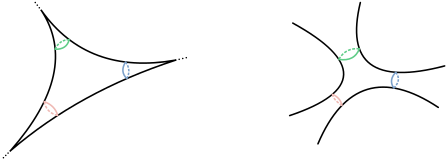
An illustration of half dilation structures on four punctured spheres, with interactive GeoGebra applets.
Dilation Structures on Four-Punctured Spheres
Not every dilation structure admits a polygonal representation. In what follows, we'll focus exclusively on triangulable dilation structures - those that do admit such representations. For brevity, we'll simply refer to these as "dilation structures."
Polygonal Representation of Four-Punctured Spheres
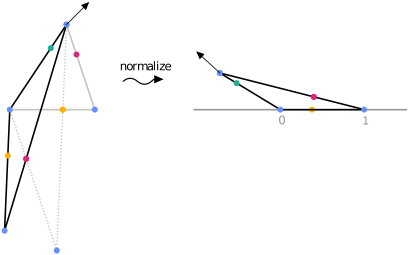
Consider a dilation structure on a sphere with four distinguished points, which we'll interchangeably call punctures or marked points depending on our perspective. Our first step is to choose one of these points (represented by the top blue point in our illustration) and connect it to each remaining point via non-intersecting paths. The complement of these cuts yields a simply connected region bounded by six edges and six vertices.
The dilation structure allows us to straighten these paths through homotopy while preserving their non-intersection property. The developing map then gives us a way to represent this region as a polygon in the plane. In the illustration, we see this process: on the left, we have our sphere with its marked points and paths, and on the right, we see how the developing map represents this particular example as a triangle-like hexagon:

Classifying Four-Punctured Dilation Structures
Every dilation structure on a four-punctured sphere necessarily has type ; this follows from a straightforward application of the Euler characteristic. We can categorize these structures based on the number of adjacent edge pairs that are glued together, with possible counts being 3, 2, 1, or 0. Note that the actual names we assign to each label don't matter here. We've already examined the case where three neighboring pairs are glued. For counts 3, 2, and 1, there exists exactly one possible pattern, while the count of 0 admits two distinct possibilities:
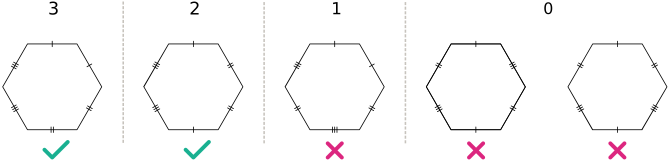
However, topological constraints eliminate all but two of these combinatorial possibilities. Only the first two polygons project to the required four vertices. Moreover, the parallel edge condition (edges with matching labels must be parallel) imposes strict geometric requirements:
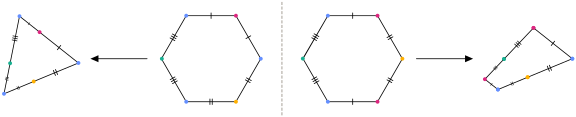
- The first case must form a triangle whose vertices project to a single point, with three 'fake' vertices positioned on the interior of each edge, projecting to our model surface's remaining three marked points
- The second case must form a quadrilateral whose vertices project to two points, with two 'fake' vertices positioned on opposite edges
The precise positioning of these fake vertices is determined by the holonomy around the respective punctures.
Isomorphism Through Cut-Paste Operations
We consider two dilation structures equivalent, or isomorphic, if they differ by what we'll call a cut-paste operation (analogous to translation surfaces, but here involving cutting, scaling, rotating, and repasting). As it turns out, our two models can be cut-and-paste into each other by cutting along certain saddle connections:
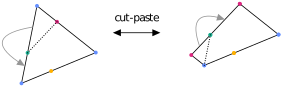
In what follows, we'll work with the triangular model to describe our dilation structures. Moving a vertex creates a different dilation structure as this changes the angles between saddle connections. Similarly, shifting the position of vertices along the edges yields distinct dilation structures. Here's an interactive illustration:
Here are two cut-paste operations on the triangular model that will play an important role later:
In particular, the three triangles (with the blue vertices) all describe the same dilation structure.
Isoholonomic Foliation of Teichmüller- and Moduli-space
When we traverse a positively oriented loop (anti-clockwise in our pictures) once around , , or , we experience a flip and a dilation by some factor. These three dilation factors , , and form what we call the holonomy of our dilation structure. Let's fix such a holonomy and examine all possible dilation structures that share these prescribed dilation factors. For our triangles, this means the "sliders" on our edges will always divide the edges with the same ratio.
There are a couple ambiguities that we haven't addressed yet.
First, when we develop our structure into a polygon, we argued that (potentially after the described cut-paste operation) it looks like a triangle with three additional vertices on the interior edges. There are two possible orderings in which the punctures can arrive:
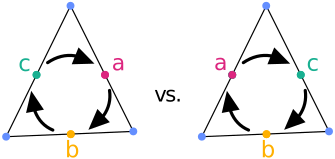
However, when we apply either one of the two cut-paste operation that we described before, we change from one order to the other. This shows that every dilation structure has a polygonal representation as a triangle where the verticies are ordered (red) -> (yellow) -> (green), which is depicted on the left in the previous picture.
Secondly, we could get a -rotated version of our polygon depending on how we develop. Here we can make the convention that we edge containing to have angle in .
Thirdly, for normalization, we scale our triangle to have unit area. We call the space of positively oriented unit area triangles (up to translation) . Positively oriented means that the edges that contain and form a positively oriented basis of (equipped with its standard basis).
The space of triangles and hyperbolic geometry
For a different normalization, we could choose an edge of our triangle - let's arbitrarily pick the edge containing vertex - and rotate and scale our triangle so that this edge lies on the real line between zero and one and that the opposite vertex is in the upper half plane. However, since dilation structures are not preserved by rotations, we must keep track of the original direction of this edge in some way. Or in other words, we want to remember what the initial vertical direction was.
A very straight forward way would be to simply remember the angle we use to rotate our triangle. Or we could simply record the (unoriented) line with the direction of the edge where containing . This would give us a way to identify with every point in a dilation structure on (the sphere with four marked points).
However, it would be nice to have a connection with hyperbolic geometry, so we want a normalization that connects this space of triangles with the unit tangent bundle and respects its geometry (more specifically its geodesic flow). For this we make use of the fact that both and the space of all triangles in the plane (up to orientation, translations, rotations by , and area) can be identified with via their usual simply transitive actions:
So after choosing an arbitrary point in and to serve as the identity element of we can identify the two spaces with each other. For , we declare that serves as our identity element and for we say that triangle with vertices , , and vertical direction corresponds to the identity element.
Comment: In principle any choice would do a fine job at tying these two spaces together, however choosing the two "identity-triangles" such that they have the same interior angles will make sure that all our corresponding triangles in and have the same interior angles as well. The tangent direction will tell us how to rotate the triangle in . This will hopefully become clearer later when we explicitly describe how given an element of one can construct the corresponding triangle in and vice versa.
Here's an interactive illustration showing different dilation structures in under this identification. You can use your mouse to manipulate the scene, try to display the dilation structure that we set as the identity element:
Interpreting "angles" in vs.
We now describe explicitly how to go back and forth between and . Using the Iwasawa decomposition any matrix can be factored as:
where , , and .
A tangent vector corresponds to the matrix where we choose , , and as the (signed) angle between and . In other words the Möbius transformation that maps to . Now we use the matrix as a linear map on and map our reference triangle under it. The resulting triangle corresponds to .
Surjectivity vs. Bijectivity in Our Mapping
The astute reader has likely noticed that our space of triangles isn't an identification with all dilation structures up to isomorphism. In fact, we've only constructed a surjective map (two in fact) from to the set of dilation structures (up to isomorphism) on our four-punctured sphere.
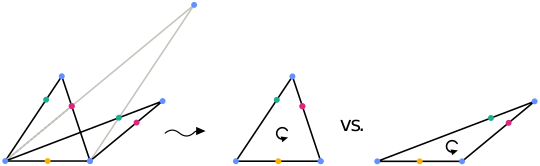
In our interactive cut-and-paste example above, we already saw that this map can't be injective. The described cut-and-paste operation gives us two different points in ... well, almost. Notice how the order of points changes. Going cyclically, we went from to , so technically this transformation doesn't abide by our convention (the resulting triangle has the opposite orientation).
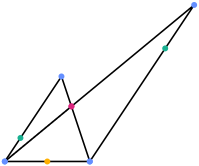
However, if we were to perform another cut-and-paste operation, we would obtain a dilation structure that follows our convention but lies at a different point in (note that the direction remains unchanged since we left the base of our triangle untouched).
Resolving the Ambiguity: The Teichmüller Space
While our map isn't a bijection, does stand in bijection with another significant space: the Teichmüller space of dilation structures. This space consists of dilation structures enriched with additional data that resolves the ambiguity (or non-injectivity) we've observed. Before providing a formal definition, let's explore our surjection in a bit more detail.
Small perturbations of our point will indeed yield different dilation structures, so our map is locally bijective. The key insight now is to enrich a dilation surface with additional data that can distinguish between dilation structures even under cut and paste operations.
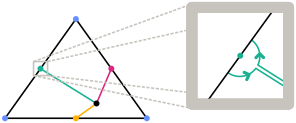
To accomplish this, we fix a basis for our fundamental domain using our base model. We select the following basis consisting of a base point in the interior of our triangle and loops , , that encircle the marked points , , exactly once. We'll represent this visually by drawing a tripod inside our polygon. It's important to note that one should conceptualize this as three loops rather than three segments. You might imagine each loop as traveling in a straight line from the base point toward a marking, encircling it in a tiny circle, and then returning along the same straight path:
Now one might (rightfully) ask why those are the only cut paste operations we should care about? We can easily imagine a cut and paste operation that is not of this type and hence gives us a different point in that projects to the same dilation structure. However, every cut paste operation (that respects our model) has to connect singularities. And for a given cut paste operation (other than the ones we've encountered) we would have to cross some of the edges. Now we can use our simple cut paste operations to 'unfold' the triangle in this direction and via this process we decompose the cut paste operation into a sequence of simple cut paste operations.
Tracking Fundamental Group Changes During Cut-Paste
Let's explore how this tripod marking helps us differentiate between structures that differ by cut and paste operations. We'll simply carry our tripod along during these transformations and observe how it changes. Here is the first cut and paste operation, which changes the order of our punctures from to :
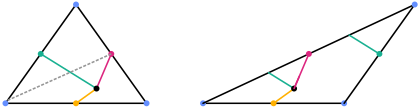
Now, applying a second similar transformation brings us back to our initial order :

Here's a simplified representation that focuses on the topological change while setting aside the specific dilation structure:
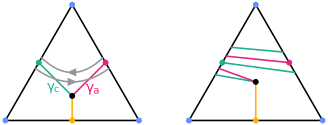
What we've demonstrated is that these two cut-and-paste operations collectively realize a Dehn twist along the loop (which is freely homotopic to minus the grey loop in the previous image).
While we've returned to our original arrangement of punctures, this process yields a new basis for the fundamental group. In terms of our original generators , this new basis can be expressed as:
Here is a more three-dimensional sketch of the loops involved. We illustrate our topological model of the four-punctured sphere via a simplex. Think of it as a folded version where the face facing the viewer is the triangle containing the base point of our fundamental group. On the right, you can see a cylinder in grey along which the Dehn twist is performed.

Definition of Teichmüller- and Moduli-space
Generators for the Mapping Class Group
It is a well-known fact that the pure mapping class group, which we denote by , is isomorphic to the free group of two generators. Two possible generators are the indicated Dehn twists, which in our case can be realized by the cut-and-paste operations described previously.
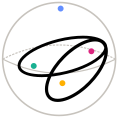
Having identified the Teichmüller space of dilation structures on four-punctured spheres with , it is natural to ask which elements of correspond to our two cut-and-paste operations. Understanding these elements will reveal the geometry of the Moduli space.
Matrix Representations of Dehn Twists
With some trigonometry, we can express our two generators for the mapping class group as follows:
For the first Dehn twist:
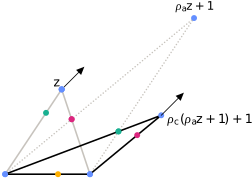
For the second Dehn twist:
Geometry of the Moduli Space
We now study the geometry of the Moduli space, that is, the unit tangent bundle of , where is the subgroup of generated by our two Dehn twists (which depend on the holonomy ).
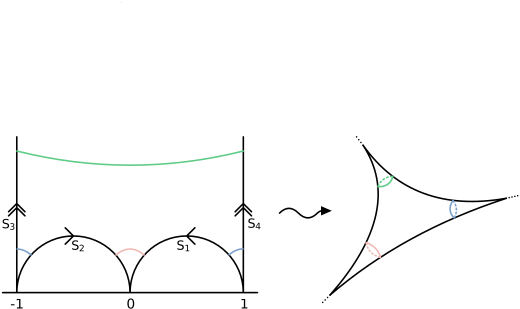
For the special case , we have that is a finite volume surface with three cusps, topologically a three-punctured sphere - another well-known result. In this case:
Here is a picture of a fundamental domain of this subgroup:
For a general , the fixed boundary points for our isometries (which uniquely determine their preserved geodesics) are:
The Quotient Space
The quotient space is a hyperbolic surface (this is an application of the ping-pong Lemma). Depending on the specific values of , this surface can take different forms:
-
When all holonomies have unit modulus (the parabolic case), we obtain a hyperbolic surface with three cusps, topologically equivalent to a three-punctured sphere.
-
When at least one holonomy has non-unit modulus (the hyperbolic case), we obtain a hyperbolic surface with funnels replacing some or all of the cusps.