Reading Seminar: Translation Surfaces and Rational Billiards - The Veech Alternative
Seminar notes exploring Vorobets' approach to the Veech alternative — the dichotomy in geodesic flow behavior on translation surfaces: trajectories are either periodic or uniformly distributed.
This post serves as lecture notes from our reading seminar at MPI MiS, where we are exploring the dynamical behaviors of geodesic flows on translation surfaces through a study of:
Ya. B. Vorobets, “Planar structures and billiards in rational polygons: the Veech alternative,” Russian Mathematical Surveys, 1996, Volume 51, Issue 5, 779-817.
The Veech alternative presents a remarkable dichotomy in the behavior of geodesic flows on certain translation surfaces: for any fixed direction, either all infinite trajectories are uniformly distributed, or all trajectories are periodic.
Note: These notes reflect my understanding of our discussions – if it were a game of telephone, consider this the final whisper. All errors and clunky phrasings are surely mine; all good ideas belong to the speakers and authors of the reference material.
Session 1 (Jiajun Shi), February 26th: Translation Structures and their connection to Billiards in Rational Polygons
Session 2 (Fabian Lander), March 5th: Interval Exchange Transformations and Elementary Translation surfaces
Last time we saw that the geodesic flow on the phase space preserves the measure where is the Lebesgue measure on (induced by the flat structure ) and is the Lebesgue measure on . In particular, if we fix a direction, we have a measure-preserving dynamical system on a full measure subset of . For simplicity, we will continue to denote this subset as .
Today we will connect this dynamical system to another closely related family of dynamical systems called Interval Exchange Transformations, or IETs for short.
Defining Interval Exchange Transformations
Given an interval and points where , an IET is a map that acts as a translation (shift) on each of the components of .
Various definitions appear in the literature. Some use half-open intervals (either left- or right-open) and require to be left- or right-continuous, meaning shifts the half-open “components”. This makes a bijection on the half open interval.
Regardless of these technical differences, the fundamental concept remains the same: We partition the interval into finitely many pieces and then rearrange them via translations.
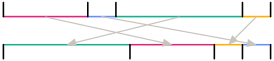
We call the set the set of singularities, break points, saddles, or discontinuities. By including the preimages of break points back into , we can see that powers of an IET are themselves IETs.
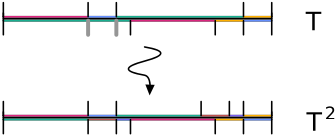
A crucial element in analyzing the dynamical properties of IETs is the set , which consists of points that are mapped into in both forward and backward time:
This set is clearly finite, because any sequence that connect two break points is unique (here we view as a bijection on the half open interval) and there are only finitely many possible combinations of breakpoints.
Another useful point of view is the following: This set is finite because of the connection between IETs and translation surfaces - specifically, points in correspond to saddle connections in the suspension of the IET. Since a translation surface has finitely many saddle connections in any given direction, must be finite as well.
Foundational Results on IETs
The following key results about IETs come from:
- [1] M. Keane, “Interval exchange transformations”, Math. Z. 141 (1975), 25-31.
- [2] M. D. Boshernitzan, “Rank two interval exchange transformations”, Ergodic Theory Dynamical Systems 8 (1988), 379-394.
1. $K_i$ consists of intervals of same length that are cyclically permuted (we say that $K_i$ is a periodic component)
2. $T$ restricted to $K_i$ is minimal, i.e., every orbit $\{T^n x \}_{n\in \mathbb{N}}$ is dense in $K_i$ (we say that $K_i$ is a minimal component)
This directly implies:
Lastly, we have a theorem regarding ergodic measures:
In the next section, we’ll explore how these interval exchange transformations relate to the geodesic flows on translation surfaces, providing a powerful tool for understanding their dynamics.
IETs and Translation Surfaces
We will now discuss how we can obtain an IET from a Translation surface .
Ingredients for an IET:
- A geodesic segment on (which may contain a singular point)
- A direction
We define as the first return map of the flow from in direction . Before proving that this is indeed well-defined, let’s examine a simple example:
Consider a translation surface (e.g., a torus) together with a horizontal geodesic segment. The first return map is not defined if we flow into a singularity. So we take the “preimages” of all possible flow lines in direction emanating from singularities as well as the preimages of the boundary points of our segment (careful there is a mistake in the picture, however a posteriori the idea still works):
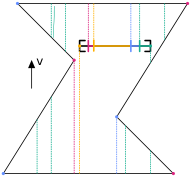
Note that since we only have removable singularities in this example, there is only one preimage per singularity. In general, the number of preimages could be up to the sum of all multiplicities of singularities. This partitions the segment into components which get mapped back to via translation:

Now we will state and prove a general result about the first return map on translation surfaces, which will formally establish that our map is indeed an IET (and in particular well-defined).
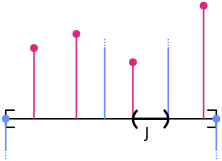
By Poincaré’s recurrence theorem, this set will eventually return to (I will elaborate on this application below). So the first return map is well-defined. By construction, all of must return to the interior of at the same time (otherwise this would contradict the definition of ). Since our flow preserves the length and orientation of our segment, has to be mapped back to by a translation.
The trajectory of forms a rectangle which has area at most that of the whole surface. Therefore, the time until the first return (or equivalently, the distance traveled) is less than .
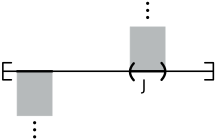
Application of Poincaré’s Recurrence Theorem to IETs
Poincaré’s recurrence theorem is a fundamental result in measure-preserving dynamical systems. It states that for any measure-preserving transformation on a probability space and any measurable set , almost every point in returns to under iterations of . More precisely, for almost every , there exists such that .
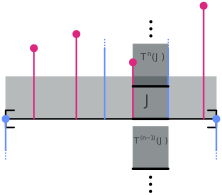
In the context of geodesic flows on translation surfaces, we can apply this theorem because the geodesic flow in a fixed direction preserves the Lebesgue measure on the translation surface , and has finite area.
We can apply the theorem to our interval because it has positive measure with respect to the measure transverse to the flow direction . More specifically, we can thicken our interval in direction to form a rectangle. Since the geodesic flow preserves rectangles, returning to our initial rectangle with base implies that the interval must return to itself at some point. Therefore, the whole component returns to under flow. This leads us to the following important observation:
Saddle Connections and Minimal Components
A saddle connection of a translation surface is a geodesic segment joining two singular points which doesn’t contain singular points in its interior. Notice that in our previous construction of IETs on translation surfaces, saddle connections in the direction play precisely the same role as the set we discussed earlier.
In essence, this means we can fully understand the geodesic flow on in any given direction by examining an appropriate IET on a transverse segment (or collection of segments). This powerful connection allows us to transfer our intuition between these two perspectives.
If the closure of these domains doesn’t cover all of , consider a geodesic segment in the complement. Its induced IET must be minimal (by Theorem 1).
We claim that the closure of the image of under the geodesic flow is bounded by (a concatenation of) saddle connections. To prove this, consider the complement of the periodic domains after removing all saddle connections in direction . We can cover this region with open rectangles whose heights are aligned with direction and whose bases are orthogonal to .
The key insight is that flow lines originating from each rectangle have a dense image within that rectangle. Consequently, any two overlapping rectangles must have identical images under the geodesic flow. This implies that the boundary of each minimal component consists of (concatenations of) saddle connections.
Since there are only finitely many possible combinations of concatenated saddle connections in a given direction, we have only finitely many minimal components. We can now collect geodesic segments from each component (both periodic and minimal) and view them collectively as a single IET that fully characterizes the dynamics of the geodesic flow, as every flow line passes through one of these segments after a finite amount of time.
Here’s a key insight worth highlighting: When constructing an IET from a geodesic flow, we can actually reconstruct the original translation surface if we carefully track additional data—specifically, which segment neighbors which segment after the first return (permutation data), how long each segment travels along its trajectory until it returns, and the distances between the saddle connections and the break points. This “suspension” of the IET effectively recreates the original surface geometry.
Now that we can analyze the dynamical behavior of the geodesic flow in any direction by examining a suitable IET, we can reformulate our earlier theorems in the context of translation surfaces.
A beautiful consequence of this analysis is the following theorem:
Finally, we can adapt Theorem 3 to the setting of translation surfaces:
Translation Surfaces out of IETs (Suspensions)
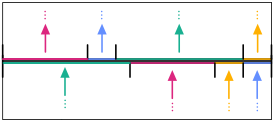
The reverse construction—building a translation surface from an IET—is remarkably straightforward. We can create a translation surface with a segment such that the vertical flow induces the same IET on that segment. The following illustration captures the essence of this construction:
Session 2.5 (Fabian Lander), March 12th: “Decomposing” a translation surfaces into IETs and defining elementary translation surfaces
Elementary Translation Surfaces
Now that we understand the connection between translation surfaces and interval exchange transformations, let’s explore some fundamental properties of translation surfaces, particularly the relationship between their topology and the singularities they contain.
First, we need the following lemma:
Let , , be the numbers of vertices, edges and faces of an arbitrary triangulation of as described in Lemma 10. Clearly, (the number of singular points) and (since each face has 3 edges, and each edge belongs to 2 faces), so Euler’s formula implies that .
The sum of all angles of all faces in the triangulation is equal to . On the other hand, it is equal to the sum of the full angles at the singular points of , that is, . Hence: and , as required.
This theorem has several interesting consequences:
-
There do not exist translation structures on the sphere. This is because for a sphere, , which would require . Since for all (as singularities must have multiplicity at least 1), this equation cannot be satisfied.
-
Translation structures on a torus can have removable singularities only. For a torus, , so we need . This is only possible if all singularities have multiplicity exactly 1, making them removable.
-
A translation structure on a surface of genus must have at least one non-removable singularity, as requires at least one .
Let’s explore the second consequence in more detail. Let be linearly independent vectors in . By we denote the quotient space of by the subgroup . Then is a torus, the canonical projection is a local homeomorphism, and the continuous maps from domains in into that are right inverse to define on a translation structure without singular points. This structure is called a flat torus.
It turns out that every translation structure on a torus can be obtained in this manner, which is formalized in the following proposition:
Let and let be a geodesic interval starting at in an arbitrary direction . The trajectory emitted from in a direction perpendicular to intersects at a point . We denote by , the distances to be travelled along and along the trajectory, respectively, from to .
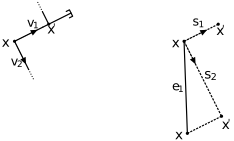
As can be readily seen, the trajectory emitted from in a direction parallel to is periodic. By Proposition 7, the whole surface is a single pencil of periodic trajectories in the direction , having the same length .
We draw the geodesic interval in a direction perpendicular to whose length is the width of the pencil of periodic trajectories in the direction . The end-points and of this interval belong to the same trajectory of the pencil; all other trajectories intersect just once.
Let be the distance from to when moving along the direction . Then the trajectories parallel to form a pencil of periodic trajectories of length . The trajectories from the pencils parallel to and intersect one another just once. This implies that the translation structure is isomorphic to the planar torus .
It is well known that on , flows parallel to vectors in are periodic, while flows in all other directions are strongly ergodic. This dichotomy represents the simplest possible dynamical behavior for geodesic flows on translation surfaces.
This definition captures a key aspect of the Veech alternative that we’re working toward—the dichotomy in the behavior of geodesic flows, where for any given direction, the flow is either completely periodic or completely ergodic with no “intermediate” behavior.
Session 3 (Magali Jay), March 19th: The Stabilizer of a Planar Structure
Let be a translation surface. Given an element we define as the translation surface obtained by post-composing charts of with , i.e. . This defines an action on the space of translation structures and we denote by the stabilizer subgroup of , i.e.,
The goal for this talk is to prove:
Given a saddle connection, we can cover its interior with a single chart. The image of the saddle connection will be a straight (open) line segment. A development of a saddle connection is a vector that corresponds to the difference of endpoints of the oriented line segment. So every saddle connection has two developments: and . We define to be the multiset containing all developments of all saddle connections. (A multiset is a set where we also remember how often an element occurs. This can be encoded using a map from the set into the positive integers.)
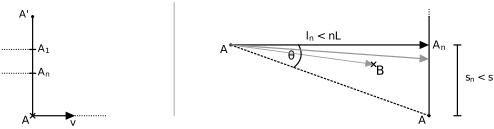
Now imagine dragging the point to . This results in a saddle connection from to itself in a direction that differs from at most by which is arbitrarily small for large . Note that if we would encounter a saddle point somewhere on the segments whilst sliding, this would give us a saddle connection between and which will have a direction even closer to .
This proves the first claim.
For the second claim, we first note that is not an accumulation point of because the length of saddle connections of is bounded from below. Now let . We draw a segment in direction of length from every saddle point. Since there are only finitely many saddle points, the flow in an orthogonal direction needs time at least to go from one segment to another one (in forward or backward time). This gives us the existence of a neighborhood of the union of all the segments that doesn’t contain any saddle points other than the ones already contained in the segments themselves.
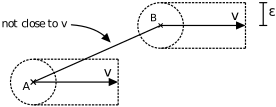
This in turn implies that a development that is close to from a saddle point is contained in this neighborhood. This concludes the proof.
We denote the minimal length of saddle connections in a translation structure by . For fixed , we define the map
and
where denotes the operator norm on . Exchanging the roles of and , we get
So if then and which proves the continuity of . Acting on by an element of doesn’t change the area of . To show that is bounded on , we will prove that . For this, take a segment of length in an arbitrary direction, and starting in some singular point . We assume that this segment doesn’t contain a saddle point besides . Drawing another segment of length orthogonal to , also with no other singularities, gives rise to a rectangle of area . We are going to assume that this rectangle contains no singularity since otherwise we would have a saddle connection of length at most . Now consider a maximal segment in on which the first return time of the flow orthogonal to is constant. This return time is at most . The boundary of maps back to .
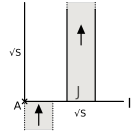
Since by assumption doesn’t contain another singularity, the “leftmost” point of has to be mapped to which give a saddle connection from to of length less than .
By non-uniform we mean that the quotient is non-compact.
To show that is non-compact, let and such that . Then
i.e. . If were compact, we could find a sequence such that .
Session 4 (Jiajun Shi), March 24th: Veech’s Theorem
We will assume that the translation structure has singular points (see the discussion in the section about Elementary translation surfaces after Theorem 9). The goal is to prove the following theorem:
To prove this theorem, we will need the following key lemma originally from
In Vorobets it is cited as follows:
Then the flow in the vertical direction is strongly ergodic.
Later we will show how this result follows from another Theorem from the late 80’s.
(There is more to write for this session.)
Session 5 (Fabian Lander), March (?): Masur’s Lemma
Let be an IET on and be the break points of . Denote by the length of the shortest interval(s) of this partition. For each we write .
For a proof we refer to: